Why Magento to Shopify Plus Migration Is Accelerating in 2026

Magento to Shopify Plus migration sits at the top of the platform decision list for mid-market and enterprise ecommerce brands in 2026 for concrete reasons. Adobe Commerce support has ended or is ending imminently, self-hosted Magento costs two to five times more monthly than Shopify Plus, and Shopify Scripts retired permanently on June 30, 2026, creating immediate checkout rebuilds across thousands of stores. Brands that execute this migration correctly protect rankings, preserve data integrity, and land on a platform that lowers operating costs while expanding commercial capability. Brands that rush the process trade Magento's problems for a new set on a different platform. This guide covers the triggers, the architecture, the process, and the outcomes.
What Broke the Magento Cost Equation in 2026
Magento delivered real value for over a decade. Deep customization, infrastructure control, and open-source flexibility gave ecommerce teams capabilities that hosted platforms could not match at the time. Those advantages always came bundled with infrastructure ownership — hosting management, security patching, PCI compliance overhead, and engineering resources dedicated to keeping the platform running rather than driving commercial growth.
In previous years, most brands judged that trade-off acceptable. In 2026, three simultaneous pressures made it structurally impossible to justify for most of them. Global ecommerce is projected to reach $6.88 trillion by year-end, representing 21.1% of all retail worldwide. The replatforming decisions Magento teams deferred through 2024 and 2025 became unavoidable in 2026 — forced by deadlines and cost gaps that made staying more expensive than migrating for the majority of brands still on the platform.
Five Forces Making the Magento Migration Decision Unavoidable in 2026
Adobe's Licensing Consolidation Ended the Free Platform Argument
Adobe consolidated Magento Open Source users toward paid Adobe Commerce Cloud licensing throughout 2026. Brands that originally adopted Magento specifically because it carried zero platform licensing cost now face mandatory licensing fees on top of all existing infrastructure overhead. The primary economic argument for staying on Magento, avoiding platform costs, disappeared as a viable position, shifting the total cost comparison decisively in favor of Shopify Plus at most revenue tiers.
Adobe Commerce Support End-Dates Created Real Compliance Exposure
Adobe Commerce 2.4.4 extended security support ends in April 2026. Adobe Commerce 2.4.5 extended support ends in August 2026. Brands running either version after those dates operate on unpatched infrastructure with direct PCI compliance exposure and no official remediation available. The situation is most difficult for the approximately 14% of Magento stores still running Magento 1 - end-of-life since June 2020, where compliance risk has been compounding without an official resolution path for years.
Shopify Scripts Retirement Forced Immediate Checkout Action
Shopify Scripts hit full end-of-life on June 30, 2026. Every brand with checkout customization, promotional discount mechanics, bundle pricing rules, or shipping logic built in Scripts had to rebuild those functions in Shopify Functions immediately, regardless of any migration plan or budget timeline. For brands already planning a move to Shopify Plus, that mandatory rebuild converted a deferred migration into an immediate project — rebuilding checkout twice on two platforms made no commercial sense.
Self-Hosted Magento Monthly Costs No Longer Withstand Scrutiny
Shopify Plus costs approximately $2,300 to $2,500 per month on a multi-year contract. Running a comparable self-hosted Magento environment costs $4,000 to $15,000 or more monthly when hosting, security patching, and development maintenance are fully included in the calculation. For most brands under $25 million in annual revenue, the monthly operating savings from moving to Shopify Plus recover the one-time migration investment within the first year, before any performance or conversion improvement is counted.
2026 Migration Data Confirms a Market-Level Structural Shift
One March 2026 industry report recorded a single Magento-to-Shopify data transfer of 267,626 entities in one month. Forty-six percent of all migrations tracked that month came from stores operating for eight or more years. Established brands with complex catalogs, long customer histories, and sophisticated integration environments are executing these migrations at scale right now, not deferring them into future planning cycles.
What the Architectural Translation From Magento to Shopify Plus Requires
The most expensive assumption any team makes entering a Magento-to-Shopify-Plus project is treating it as a data export and import rather than an architectural translation. Both platforms serve the same ecommerce functions through fundamentally different structural approaches. Teams that discover those differences during the build pay for the misunderstanding in scope additions, timeline delays, and budget overruns that correct upfront mapping would have prevented entirely.
Core architectural translations every migration must address before scoping begins:
EAV attributes → Metafields and Metaobjects: Magento's Entity-Attribute-Value database structure has no direct Shopify equivalent. Custom product attributes must be mapped deliberately onto metafields and metaobjects at the field level — this is a planning task that cannot be deferred to the build phase without introducing scope problems.
Multi-store setup → Shopify Markets: Magento's multi-website architecture maps to Shopify Markets, handling regional pricing, currency, language, and localization from one Shopify Plus organization with up to nine expansion stores under shared billing and consolidated reporting.
Customer groups → Native B2B catalogs: Company accounts, custom pricing lists, net payment terms, and a dedicated B2B storefront all run natively inside Shopify Plus. Features requiring third-party applications or custom backend development on Magento become standard platform configuration tasks.
Custom checkout scripts → Checkout Extensibility and Shopify Functions: All checkout logic moves to Shopify's Checkout Extensibility framework built on Rust and JavaScript. Everything previously in Magento's backend or in Scripts must be rebuilt here before DNS cutover — not after it.
URL structure: Shopify enforces fixed /products/ and /collections/ URL patterns that almost never match Magento's existing URL structure. Every legacy URL requires a documented 301 redirect built before cutover. Missing redirects produce organic ranking losses that take months to recover from, rather than the days most teams assume when they underestimate this step.
The 7-Step Migration Process That Protects Rankings, Data, and Revenue
Most migration failures trace back to steps compressed under schedule pressure rather than technical challenges that were genuinely unavoidable. The full ecommerce migration checklist covers 18 specific dependencies, particularly around search ranking protection, that most abbreviated guides omit and that most post-launch problems trace directly back to when examined after the fact.
Step 1: Discovery and Audit
Document catalog complexity, EAV attribute volume, and every integration across ERP, 3PL, ESP, loyalty, and analytics systems completely before anything moves. Build a rollback plan with defined triggers at this stage. Teams that skip discovery encounter scope problems during the build when corrections are slower and more expensive than they would have been during planning before any development work was committed.
Step 2: Strategy and Scoping
Choose between the Liquid theme and the headless Hydrogen architecture based on traffic volume, long-term performance requirements, and team capacity to support the approach. Map every Magento extension against its Shopify equivalent explicitly and document gaps. Assuming feature parity without checking produces scope surprises during development that compress timelines and inflate costs when they surface mid-project rather than during planning.
Step 3: Data Migration
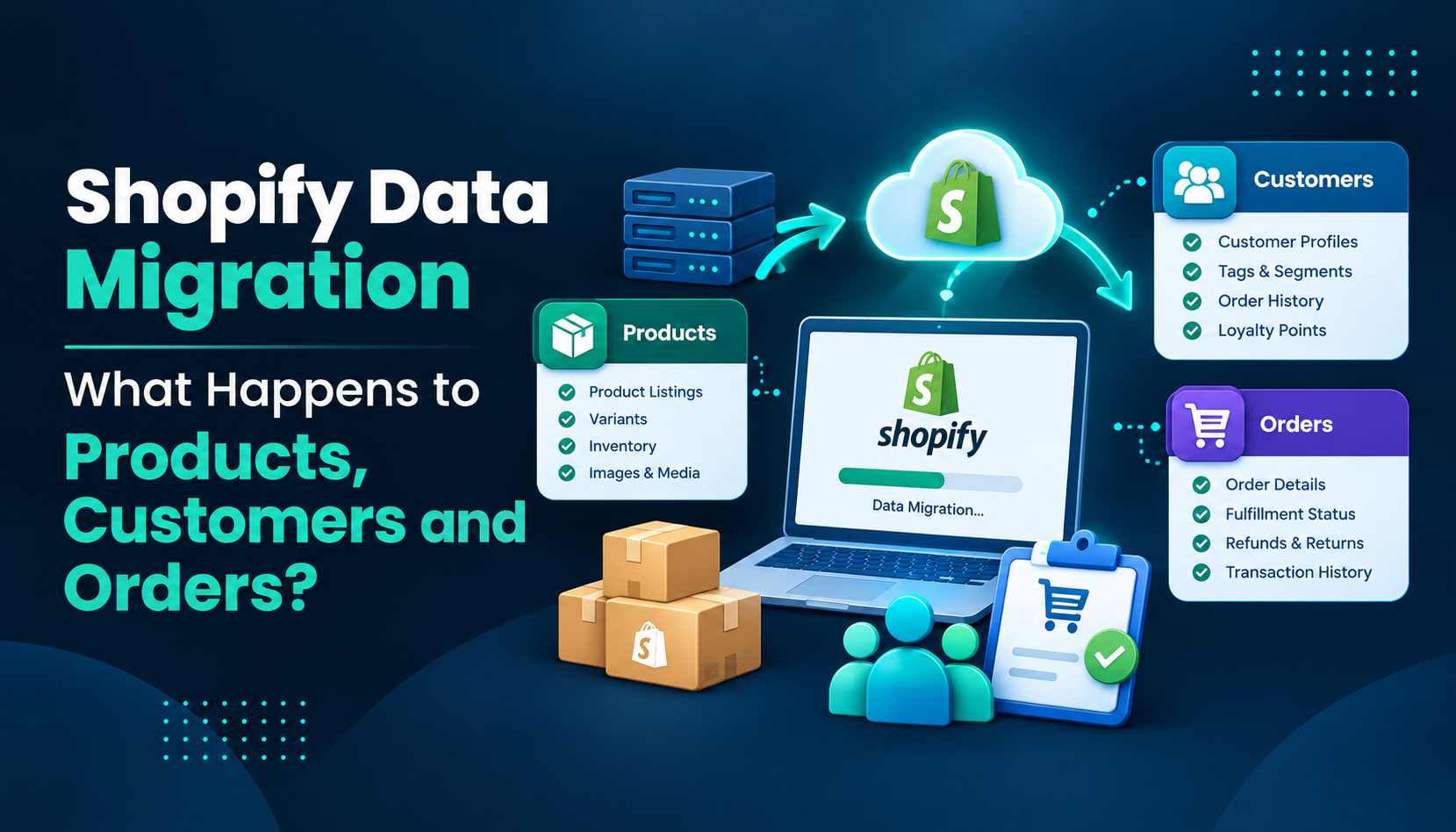
Transfer products, customers, complete order history, blog content, and CMS pages with structured validation at every stage. Running migration without validation creates catalog and customer record errors that surface post-launch, where correcting them disrupts live operations and costs substantially more than catching them during the controlled migration environment.
Step 4: SEO Redirect Mapping
Build 301 redirects covering every legacy Magento URL. Carry meta titles, descriptions, and schema markup over without changes. Shopify Plus SEO execution runs as a dedicated parallel workstream alongside the technical build, not as a post-launch cleanup task. Post-cutover organic recovery consistently costs more, takes longer, and delivers less predictable results than ranking protection executed correctly during the build phase.
Step 5: Storefront and Checkout Build
Build the storefront against Core Web Vitals targets, LCP under 2.5 seconds and INP under 200ms on mobile. Configure Checkout Extensibility completely and activate Shopify Plus features, including Shop Pay, native B2B tools, and Shopify Markets, during this phase rather than deferring them. Post-launch feature activation creates additional project cycles that delay commercial benefits, the migration was specifically scoped to deliver from the first day of operation on the new platform.
Step 6: Soft Cutover
Route a defined percentage of live traffic to the new Shopify Plus environment while Magento remains active for approximately two weeks. This controlled overlap window catches order-routing failures, webhook errors, and integration gaps at low traffic exposure before full DNS cutover commits every customer interaction to the new platform, where problems reach maximum commercial impact with no fallback available.
Step 7: Post-Launch Monitoring
Run daily Google Search Console reviews for the first 14 days, covering crawl errors, indexing status, and Core Web Vitals against pre-migration baselines. Follow with a full 60-day benchmark review against documented pre-migration performance. Running the migration to GA4 as a parallel workstream from project start ensures historical data remains intact rather than disappearing in the same window as the platform transition.
What Brands Achieve After a Well-Executed Migration to Shopify Plus
Infrastructure Overhead Drops Immediately and Permanently
Shopify Plus removes server management, patching cycles, and infrastructure scaling decisions entirely. Engineering capacity previously consumed by platform maintenance redirects toward commercial features and growth initiatives from the first week after launch. That reallocation compounds directly into site performance — and site speed remains one of the most consistent and measurable levers in conversion rate optimization at every traffic volume and category type.
B2B and Multi-Market Capability Runs Natively Without Dependencies
Company accounts, custom pricing, net payment terms, and regional market configuration all operate inside Shopify Plus without third-party application stacks or custom integration chains. Features requiring significant development investment and ongoing maintenance on Magento become standard configuration tasks, reducing direct cost and eliminating the stability risks that application dependency chains created across the previous platform environment.
Checkout Conversion Improves Without Additional Development Investment
Shop Pay and Shopify's mobile-optimized checkout deliver faster completion rates than most custom Magento checkout implementations without requiring post-migration build work to achieve. For brands where checkout abandonment represents a significant revenue gap, this improvement typically produces a measurable return on migration investment faster than any other single outcome. Structured conversion funnel analysis after launch identifies specific remaining friction points rather than assuming the platform switch resolves every conversion challenge on its own.
Documented Client Results Show the Commercial Impact Is Reproducible
Southern Season migrated from Magento Cloud to Shopify Plus and recorded a 200% increase in store footfall, over 166% higher average order value, and 150% ROI growth after the move. These outcomes resulted from combining platform capability improvement with deliberate post-migration optimization — not from the platform change alone without structured follow-through.
Four 2026 Factors Reshaping Migration Scope
Agentic Commerce Support Is a Launch Requirement in 2026
Migrations now scope UI extensions and Model Context Protocol support at launch so AI-driven shopping assistants interact with product-discovery layers from day one. Brands that defer this to a post-launch phase typically rebuild those integrations ahead of their planned timeline when operational necessity arrives sooner than anticipated.
Headless Hydrogen for Brands Where Standard Performance Is Insufficient
High-volume brands leaving Magento choose Shopify's Remix-based Hydrogen framework when standard themed store performance cannot meet their load time requirements. Shopify Plus development at the headless level delivers sub-second load times while retaining Shopify Plus's managed backend and checkout. This is now standard scope for brands with the traffic volume that justifies the build investment — not an advanced future consideration.
Shopify Functions Rebuild Is a Hard Pre-Launch Dependency
With Scripts retired on June 30, 2026, rewriting Ruby-based checkout logic into Shopify Functions is a mandatory technical requirement before DNS cutover on every 2026 migration. Teams that classify this as optional post-launch work discover it blocks cutover when the dependency surfaces close to the launch date, adding unplanned cost and delay at the most disruptive stage in the project lifecycle.
Regional Configuration Must Enter Scope From Project Initiation
Brands with regional operations build Shopify Markets configuration, local payment gateway integration, and mobile-first design into the initial migration scope. Retrofitting regional capabilities after launch consistently costs more time and development budget than scoping them correctly from the project start, while delaying commercial performance in those markets during the gap between launch and regional feature availability.
How Krish TechnoLabs Executes Magento to Shopify Plus Migrations
As a certified Shopify Plus partner with over two decades of ecommerce experience, Krish runs Magento-to-Shopify-Plus migrations end-to-end, covering discovery and audit, SEO-safe data migration, storefront and checkout build, B2B and Shopify Markets configuration, and post-launch monitoring through the complete 60-day performance review period.
Beyond initial migrations, the team supports brands through Shopify migration services for moves from other platforms and Shopify to Shopify Plus migration services for brands already in the Shopify ecosystem that have scaled past what standard Shopify supports at their current revenue and operational complexity.
The complete Magento to Shopify Plus migration guide covers the full process at the technical depth and sequencing detail that enterprise migrations require, including the specific dependencies and edge cases that standard migration timelines consistently underestimate and that compressed project schedules surface as avoidable late-stage blockers.
A Magento to Shopify Plus migration executed correctly, with honest architectural translation, parallel SEO execution, and structured post-launch monitoring, produces a faster store, lower monthly operating costs, native B2B and multi-market capability, and a platform aligned with where ecommerce is heading over the next several years. The same migration executed with compressed discovery and deferred SEO work produces a new platform carrying familiar operational problems. The process determines the outcome as much as the platform selection does, and in 2026, executing it correctly the first time costs substantially less than addressing what compressed execution leaves behind.
About the author
- Krish TechnoLabs is an AI-led digital experience agency specializing in Commerce, MarTech, AI & Data solutions to help brands accelerate growth and deliver exceptional customer experiences.
Comments
Join the discussionNo comments yet. Be the first to comment.